
How to Use Calming Pheromones for Cats During Moving or Vet Visits
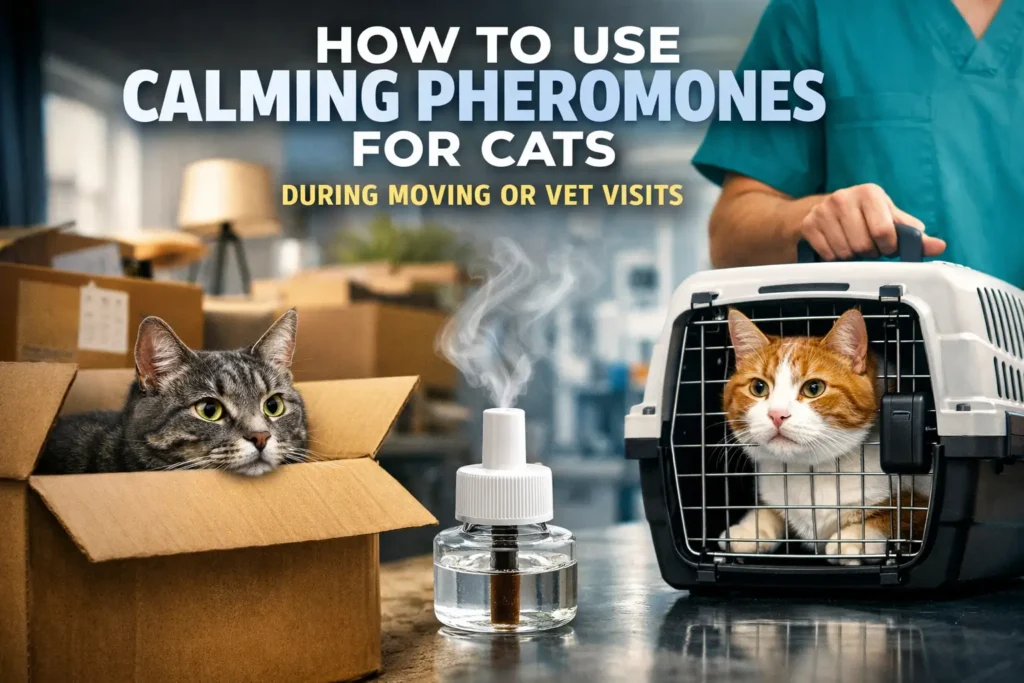
Picture this: you pull out the cat carrier, and within seconds, your cat has vanished under the bed like a furry ghost. Sound familiar? 😅 If you’ve ever wrestled a panicked cat into a carrier or watched your usually sweet kitty transform into a hissing tornado at the vet’s office, you already know how stressful these moments can be — for both of you. The good news? Learning how to use calming pheromones for cats during moving or vet visits can genuinely change the game. These science-backed products mimic the natural chemical signals cats use to feel safe, and when used correctly, they can turn a chaotic vet trip or a terrifying move into something much more manageable.
In this guide, I’ll walk you through everything you need to know — what pheromones actually are, which products work best for which situations, and the exact steps to use them effectively. Let’s make life easier for you and your cat. 🐱
Key Takeaways
- 🧪 Cat calming pheromones are synthetic copies of natural chemical signals cats produce when they feel safe and content.
- 🏠 Different pheromone types target different stress responses — choosing the right one matters for moves vs. vet visits.
- ⏱️ Timing is everything — applying pheromones 15–30 minutes before a stressful event dramatically improves effectiveness.
- 💊 Five product formats exist (sprays, diffusers, collars, treats, wipes), each suited to specific situations.
- 📊 Research supports their use — studies show significant reductions in stress behaviors, with one study finding cortisol reduction in 75% of cats monitored over 35 days [2].
What Are Cat Calming Pheromones and How Do They Work?
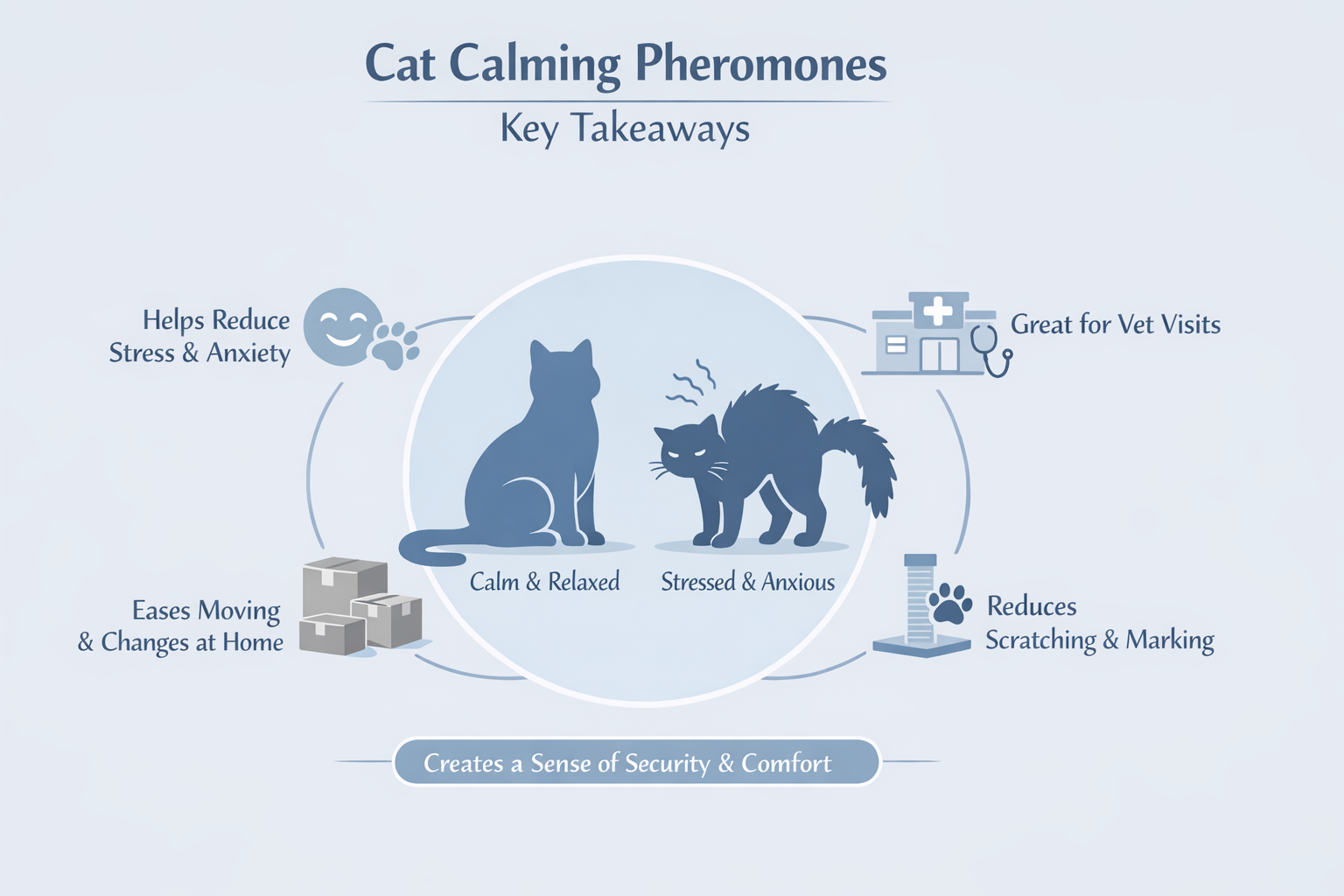
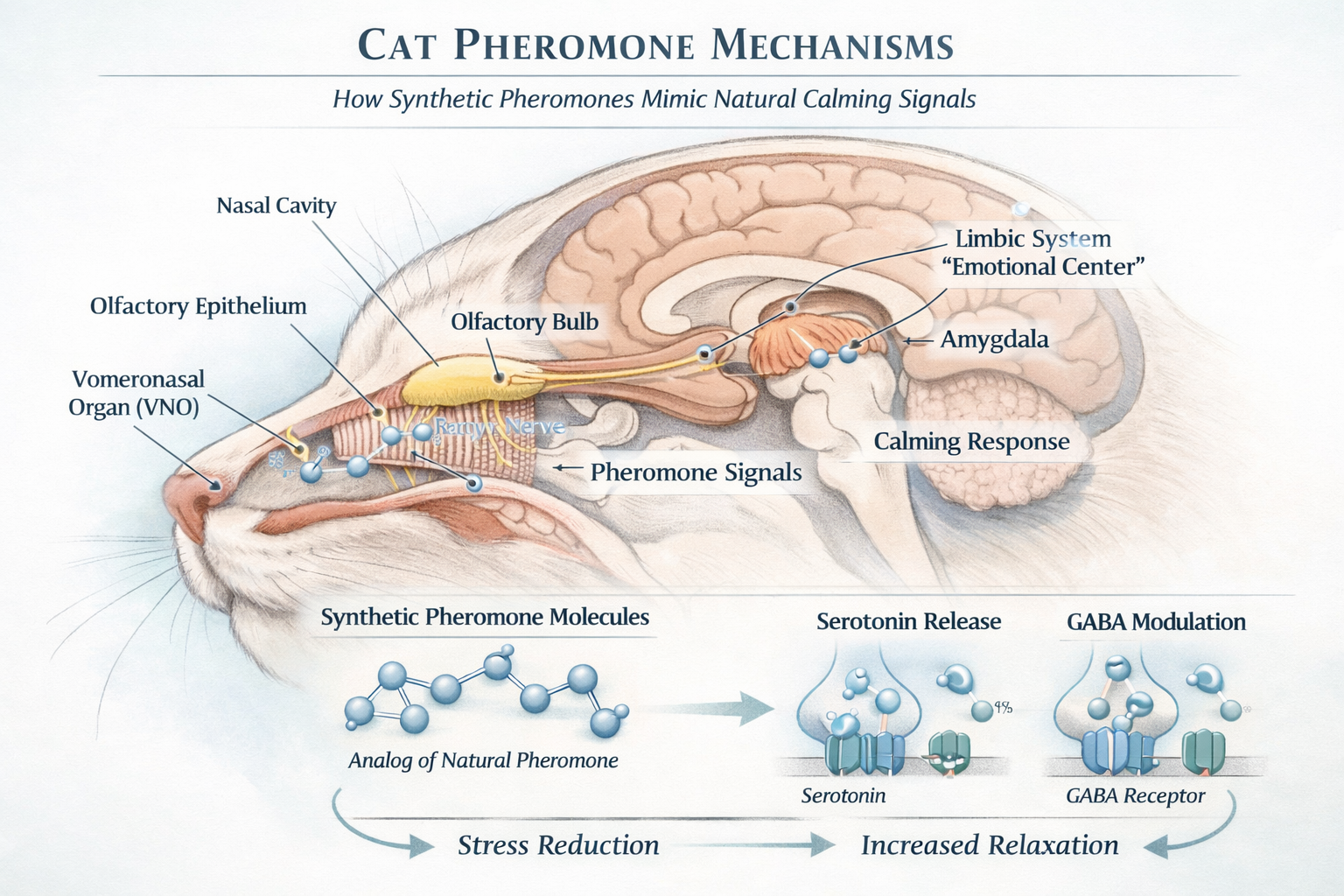
Before diving into the how, it helps to understand the what. Cats communicate in ways humans can’t see or smell — through chemical signals called pheromones. These invisible messengers are produced by glands on your cat’s face, paws, and body. When your cat rubs their cheek on your leg or the corner of the couch, they’re depositing facial pheromones that essentially say, “This place is safe. I belong here.”
Calming pheromone products are synthetic versions of these natural signals. They don’t sedate your cat or change their personality — they simply send a chemical message to the brain that says, “Everything is okay.”
The Main Types of Cat Pheromones
Not all pheromones do the same job. Here’s a quick breakdown [4]:
| Pheromone Type | Natural Source | What It Does | Common Product |
|---|---|---|---|
| F3 Facial Pheromone | Cat’s cheek glands | Reduces urine marking, promotes exploration | FELIWAY Classic |
| F4 Facial Pheromone | Cat’s cheek glands | Reduces aggression toward unfamiliar beings | Felifriend |
| Mammarial Appeasing Pheromone (MAP) | Nursing mother cats | General calming, reduces inter-cat tension | Feli-MultiCat |
For most moving and vet visit situations, F3 pheromones are your go-to. Research shows that F3 analogues — like FELIWAY Classic Spray — significantly reduce stress scores when cats encounter new environments and unfamiliar people, which is exactly what happens at the vet or during a move [2].
💬 “Pheromones don’t drug your cat — they speak your cat’s own language.”
The science is solid. Studies show that F3 water-based mist treatments increased natural rubbing behavior and encouraged exploration in stressed cats, meaning the pheromones actually promote your cat’s own stress-coping mechanisms rather than overriding them [2]. You can explore more about the evidence behind these products in this honest 2026 review of calming pheromones for cats.
How to Use Calming Pheromones for Cats During Moving
Moving is one of the most stressful events in a cat’s life. Cats are deeply territorial animals — their entire sense of security is tied to familiar smells and spaces. When you start packing boxes, rearranging furniture, and eventually transporting your cat to a completely new home, you’re essentially dismantling their entire world.
Here’s how to use calming pheromones strategically throughout the moving process.
Step 1: Start Early — Before Moving Day
Don’t wait until moving day to introduce pheromones. Ideally, start 2–4 weeks before the move.
- Plug in a pheromone diffuser in the room where your cat spends the most time. This builds a baseline of calm in their environment before the chaos begins.
- Comfort Zone diffusers, for example, contain 5% pheromone concentration and are proven 95% effective at reducing urine marking — a common stress behavior during moves [5].
- As you start packing, your cat will notice the disruption. Having the diffuser running helps buffer that anxiety.
Step 2: Create a Safe Room
As moving day approaches, designate one room as your cat’s safe haven.
- Move their bed, litter box, food, and water into this room.
- Spray FELIWAY Classic Spray on the bedding and in the corners of the room (avoid spraying directly on your cat).
- Keep this room closed during the busiest parts of moving day so your cat isn’t overwhelmed by movers and open doors.
Step 3: Prepare the Carrier
Your cat needs to be transported, which means the carrier is unavoidable. Here’s how to make it less terrifying:
- Spray the inside of the carrier with a pheromone spray at least 15–30 minutes before your cat goes in. This allows the alcohol carrier to evaporate, leaving only the calming pheromone behind.
- Place familiar bedding inside the carrier — something that already smells like home.
- If your cat will be wearing a pheromone collar, put it on 24 hours before the move for maximum effect. Studies show pheromone-impregnated collars can be twice as effective as control groups at stopping stress-related behaviors after 28 days [3].
Step 4: During the Move
- Keep the carrier covered with a light blanket to reduce visual stimulation.
- Avoid playing loud music in the car.
- If you have a pheromone spray, you can give the carrier interior a quick refresh during a long drive — just make sure your cat isn’t inside when you spray.
Step 5: Setting Up the New Home
This is where many cat owners drop the ball. The work doesn’t stop when you arrive at the new place.
- Spray pheromones in the new home before your cat arrives — focus on corners, doorways, and resting spots.
- Set up a new safe room immediately and plug in a diffuser.
- Let your cat explore gradually, one room at a time, rather than releasing them into the full house right away.
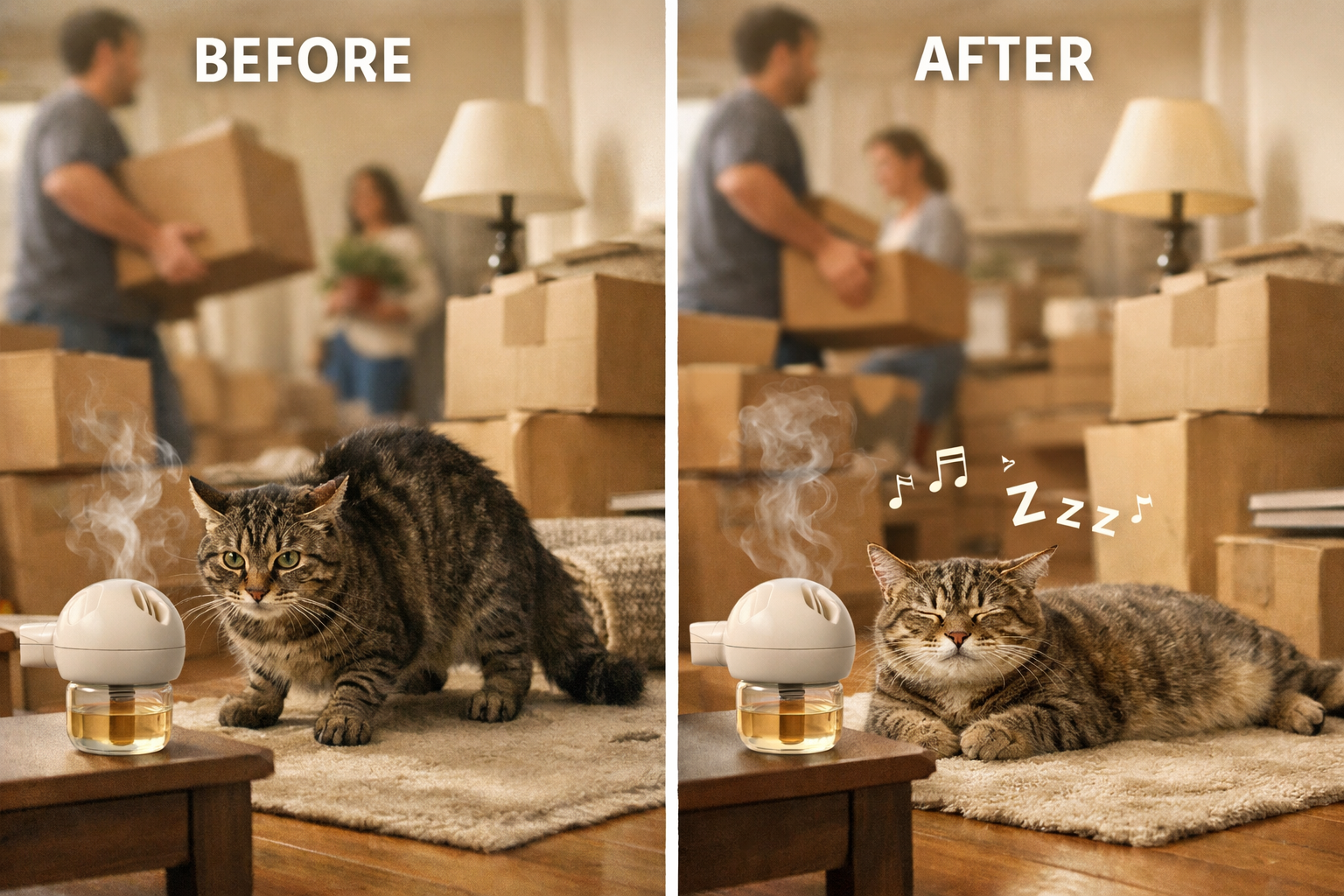
- Keep the diffuser running for at least 4 weeks after the move to help your cat establish new territorial markers.
💡 Pro tip: User data shows 93% of calming pheromone diffuser and spray users noticed significant reductions in scratching and stress-related urination behaviors [5]. These are exactly the behaviors that spike during a move.
For more strategies beyond pheromones, check out these natural and fast-acting cat stress relief solutions that work well alongside pheromone therapy.
How to Use Calming Pheromones for Cats During Vet Visits
Vet visits are a different kind of stressful. The car ride, the strange smells, the sounds of other animals, the examination table — it’s a sensory overload for most cats. Knowing how to use calming pheromones for cats during moving or vet visits means having a slightly different playbook for each situation.
The Night Before: Carrier Prep
Most cats associate the carrier with bad things because it only comes out before vet trips. Break this pattern:
- Leave the carrier out in your home at all times so it becomes part of the furniture.
- Spray the inside with FELIWAY Classic Spray the night before and again 15–30 minutes before the appointment.
- Place a worn T-shirt or familiar blanket inside — your scent is naturally calming to your cat.
The Morning of the Appointment
- Apply a pheromone collar if your cat tolerates wearing one. Put it on at least 2 hours before the visit for best results.
- Avoid feeding your cat a large meal right before travel to reduce nausea risk.
- Spray the car seat or back area where the carrier will sit — this extends the calming environment beyond just the carrier itself.
At the Vet’s Office
Here’s something many cat owners don’t know: you can ask your vet’s office to use pheromones too.
- Many progressive veterinary practices now use pheromone diffusers in their waiting rooms and exam rooms. Don’t be afraid to ask if they have one.
- Keep your cat’s carrier covered with a blanket in the waiting room to block visual stressors like dogs or other cats.
- If your cat is particularly anxious, ask the receptionist if you can wait in your car and be called in when the exam room is ready — this skips the stressful waiting room entirely.
During the Examination
- Research confirms that F3 pheromone analogues reduced stress scores during cats’ first encounters with new humans and unfamiliar environments [2]. This is exactly the vet exam scenario.
- If your vet allows it, keep a pheromone-sprayed cloth near your cat’s face during the exam.
- Speak calmly and avoid making sudden movements — your energy affects your cat’s stress level too.
After the Visit
- When you get home, don’t immediately let your cat out of the carrier into a chaotic environment.
- Let them exit on their own terms in a quiet room.
- If you have multiple cats, be aware that returning cats can smell like the vet and trigger aggression from housemates. A diffuser running at home helps smooth this transition.
Choosing the Right Pheromone Product Format
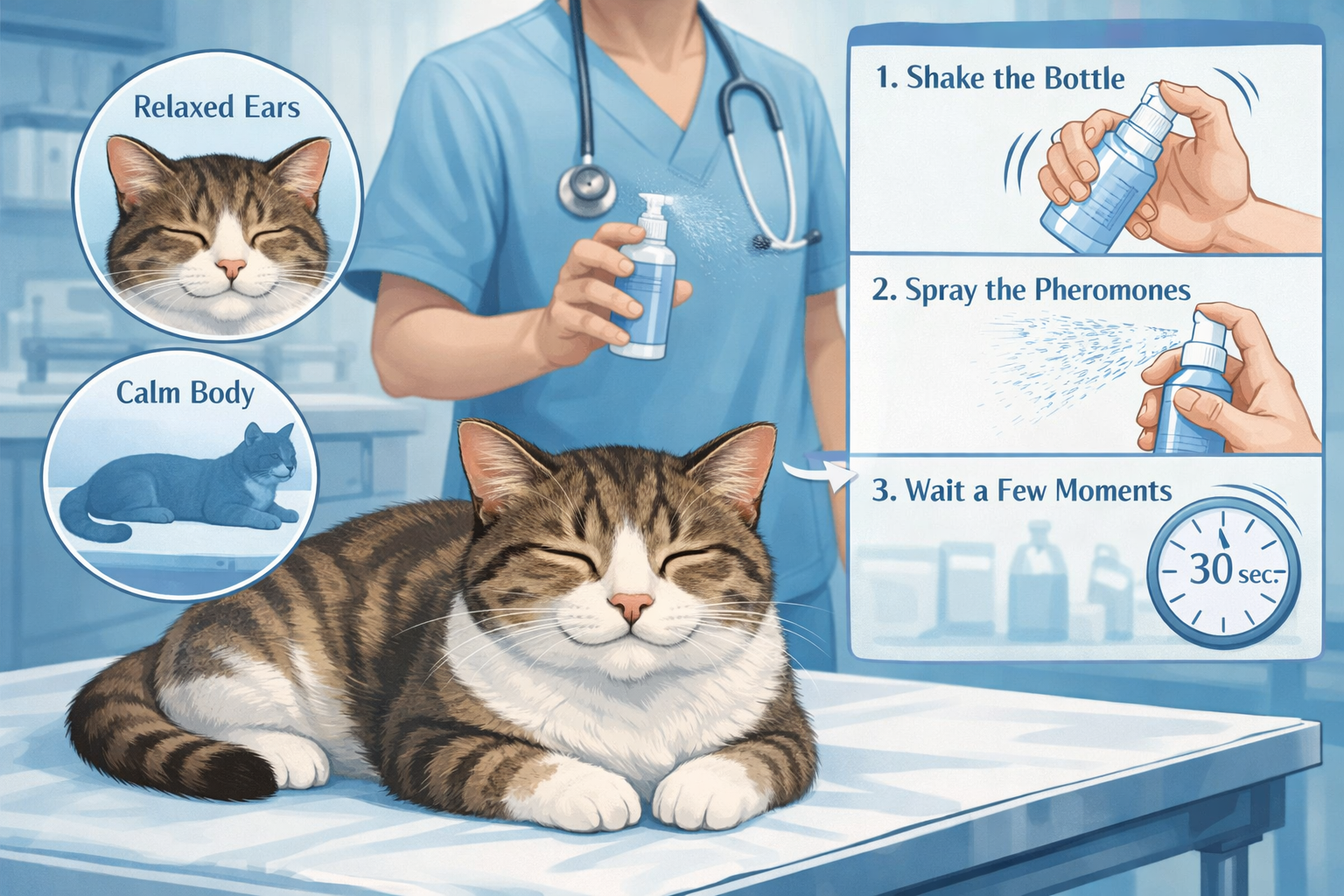
One of the most common mistakes cat owners make is grabbing the first pheromone product they see without considering whether the format suits their situation. There are five main product formats, and each has its sweet spot [1]:
🔌 Diffusers (Plug-In)
Best for: Long-term stress management, moving into a new home, multi-cat households
- Covers approximately 700 sq ft
- Runs continuously for 30 days
- Ideal for setting up a new home before and after a move
- Comfort Zone diffusers contain 5% pheromone concentration vs. Feliway’s 2% [5]
💨 Sprays
Best for: Carrier prep, car travel, vet visits, spot treatments
- Fast-acting — works within 15–30 minutes
- Apply to bedding, carrier interior, and car
- Never spray directly on your cat
- Reapply every 4–5 hours during extended travel
🪢 Collars
Best for: Cats that need continuous, portable calming (travel, recovery, anxiety-prone cats)
- Provides 24/7 pheromone release directly near the cat’s nose
- Studies show pheromone collars were twice as effective as control groups in stopping undesirable behaviors after 28 days [3]
- Lasts approximately 30 days
- Great for the entire moving period
🦴 Treats
Best for: Mild anxiety, cats that resist other formats
- Combines pheromones with calming supplements (often L-theanine or chamomile)
- Easy to administer
- Less targeted than sprays or diffusers
🧻 Wipes
Best for: On-the-go use, quick application before vet visits
- Portable and convenient
- Wipe on bedding, carrier, or exam table
- Good backup option when spray isn’t practical
Quick Comparison Table
| Format | Best Situation | Duration | Ease of Use |
|---|---|---|---|
| Diffuser | Moving, new home | 30 days continuous | ⭐⭐⭐⭐⭐ |
| Spray | Vet visits, carrier prep | 4–5 hours | ⭐⭐⭐⭐ |
| Collar | Travel, ongoing anxiety | 30 days | ⭐⭐⭐ |
| Treats | Mild stress, picky cats | Per dose | ⭐⭐⭐⭐⭐ |
| Wipes | Quick on-the-go use | 2–3 hours | ⭐⭐⭐⭐ |
The calming pheromone market is growing fast — projected to reach USD 2.78 billion by 2032 from USD 1.38 billion in 2026 [1] — which means more product options are hitting shelves every year. For the latest product reviews and comparisons, browse the pheromone products archive at Pet Serenity Hub or check out the calming aids and supplements section for a broader range of options.
Common Mistakes to Avoid
Even the best pheromone products won’t work if you use them incorrectly. Here are the most common pitfalls:
❌ Spraying Directly on Your Cat
Pheromone sprays contain alcohol as a carrier. Spraying directly on your cat can irritate their skin and actually increase stress. Always spray on surfaces and let it dry before your cat comes into contact.
❌ Not Giving It Enough Time
Sprays need 15–30 minutes to dry and activate. Spraying the carrier right before you shove your cat in defeats the purpose.
❌ Using the Wrong Product for the Situation
A diffuser is useless for a vet visit. A spray is insufficient for a month-long move. Match the format to the scenario.
❌ Expecting Instant Miracles
Pheromones are not sedatives. For very anxious cats, they work best as part of a broader calming strategy that includes environmental management, positive carrier training, and sometimes veterinary-prescribed medication for extreme cases.
❌ Forgetting to Replace Diffuser Refills
A diffuser that’s run out of pheromones is just a plastic plug in the wall. Set a monthly reminder to check and replace refills.
❌ Ignoring Multi-Cat Dynamics
If you have multiple cats, the stress of one cat can trigger anxiety in others. Use diffusers in shared spaces and consider Feli-MultiCat (mammarial appeasing pheromone) which is specifically formulated for multi-cat households [4].
For a comprehensive look at all your options, the guides and tips for pet owners section has in-depth resources on managing multi-cat stress and more.
A Real-Life Story: Luna’s Moving Day Transformation
Let me share a quick story. My friend Sarah adopted Luna, a three-year-old tortoiseshell, two years before a cross-country move. Luna was the kind of cat who hid under the bed when a stranger knocked on the door — deeply sensitive and easily spooked.
When Sarah first tried to get Luna into a carrier for a vet visit, it took 45 minutes, a pair of oven mitts, and a lot of apologies. She was desperate for a better solution.
On a vet’s recommendation, Sarah started using FELIWAY Classic Spray on the carrier two weeks before the move, leaving it open in the living room with a sprayed blanket inside. She also plugged in a diffuser in Luna’s favorite room.
By moving day, Luna walked into the carrier on her own. 😮 Not without hesitation — but on her own. Sarah sprayed the inside of the new home’s main room before Luna arrived, and set up a diffuser immediately.
“It wasn’t magic,” Sarah told me. “Luna still hid for the first day. But by day three, she was exploring the new apartment. That used to take her two weeks.”
That’s the realistic expectation with pheromones: not perfection, but meaningful improvement.
When Pheromones Alone Aren’t Enough
Pheromones are powerful tools, but they’re not a cure-all. If your cat has severe anxiety, you may need to combine pheromone therapy with:
- Behavioral training — gradual desensitization to the carrier and car
- Veterinary-prescribed anxiolytics — medications like gabapentin, which many vets now recommend before stressful vet visits
- Natural supplements — L-theanine, valerian, or CBD (consult your vet first)
- Environmental enrichment — puzzle feeders, vertical space, and hiding spots to reduce baseline stress
If your cat’s anxiety is affecting their quality of life beyond just vet visits and moves, it’s worth a conversation with your veterinarian about a comprehensive anxiety management plan. You might also find helpful ideas in our broader calming aids and tips for cat and dog owners.
Conclusion: Your Action Plan for a Calmer Cat
Understanding how to use calming pheromones for cats during moving or vet visits isn’t complicated — but it does require planning ahead and using the right product in the right way. Here’s your quick action plan:
✅ For Vet Visits:
- Leave the carrier out year-round
- Spray the carrier interior 15–30 minutes before use
- Consider a pheromone collar for the day of the visit
- Ask your vet about pheromone use in the exam room
✅ For Moving:
- Start diffusers 2–4 weeks before the move
- Create a safe room with pheromone-sprayed bedding
- Use a collar for the transport day
- Spray the new home before your cat arrives
- Keep a diffuser running for 4 weeks post-move
Pheromones won’t eliminate all stress — cats are cats, after all. But used correctly, they can make a real, measurable difference in your cat’s wellbeing and your own sanity. The research backs it up, thousands of cat owners swear by it, and your cat deserves every tool you can give them to feel safe in a sometimes-scary world. 🐾
References
[1] Calming Pheromone Products For Cats – https://www.360iresearch.com/library/intelligence/calming-pheromone-products-for-cats
[2] PMC12961128 – https://pmc.ncbi.nlm.nih.gov/articles/PMC12961128/
[3] Frontiers in Veterinary Science – https://www.frontiersin.org/journals/veterinary-science/articles/10.3389/fvets.2024.1468634/full
[4] Texas Tech University Animal Welfare Research – https://www.depts.ttu.edu/animalwelfare/research/pheromones/cat.php
[5] Best Cat Calming Plug In Pheromone Diffusers – https://www.catmumjournal.co.uk/post/best-cat-calming-plug-in-pheromone-diffusers